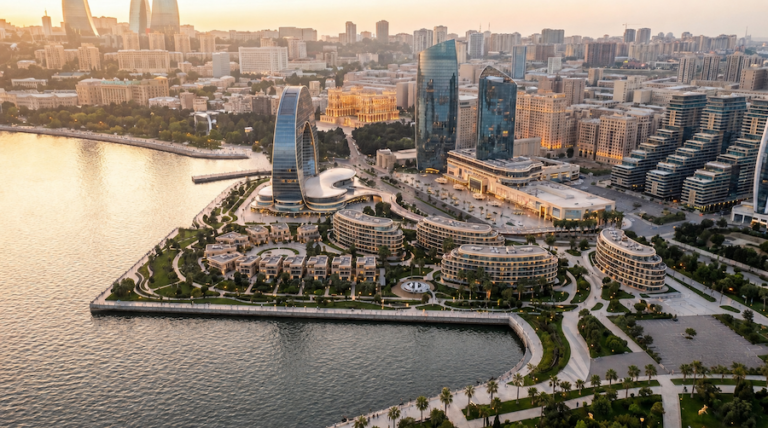



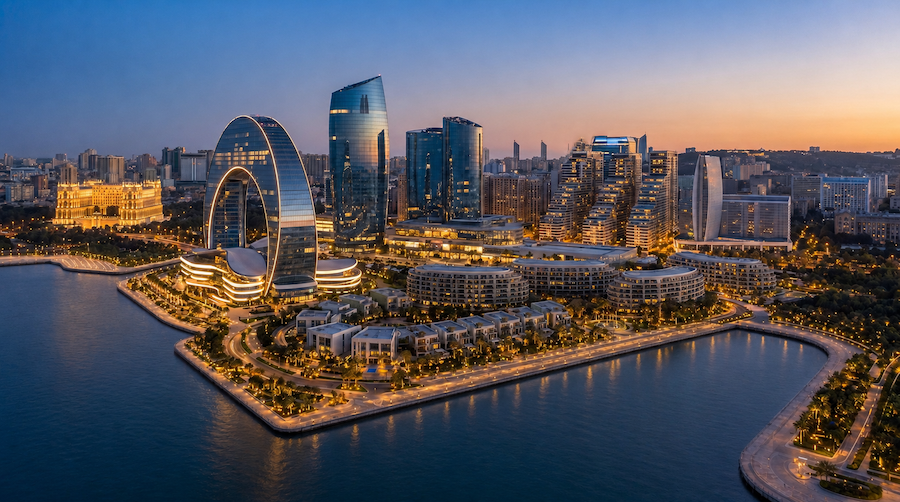
Baku does not look like the city many Western investors carry in their heads. The promenade along the Caspian fills up at dusk, cafés spilling onto the pavement beneath the glass curves of the Flame Towers, the whole scene feeling closer to the Mediterranean than to anything post-Soviet. Visitors are often struck by how clean and safe the city feels next to the European capitals they know. “Including London,” he says, “which I love, by the way.” There is a private bank that recently went public for the first time in the country’s history, a port expanding faster than its planners can pour concrete, and a CEO who will tell you, without a trace of boosterism, that the world has simply not caught up to what Azerbaijan already knows about itself.
That voice belongs to Jalal Gasimov, who runs PASHA Holding, the largest private conglomerate in the country, with more than 25,000 employees and operations stretching from Baku to Tashkent to New York. PASHA Bank recently completed the first private company listing in the history of the Baku Stock Exchange, drawing more than 18,000 investors, a milestone Gasimov calls a turning point not just for his firm but for the country’s entire financial architecture. “For a healthy economy, you need both investors willing to buy and companies willing to open themselves up,” he says. “We wanted to be the ones who went first.”
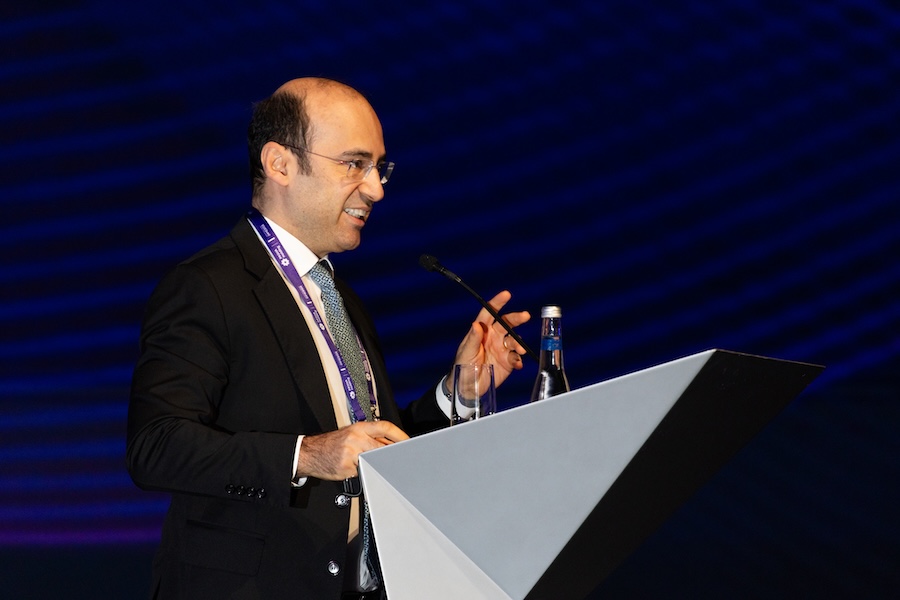
Going first is something of a theme with Gasimov, who is not yet forty-seven and has spent his career watching Western capital misread the region he calls home. The mistake, he argues, is not economic but a failure of imagination about people. “When investors from Europe or the United States think about who the best leaders are, they assume it is wherever the best universities happen to be,” he says. “But look at who actually built something lasting in a market like ours. They did it while legislation shifted under their feet, while institutions were still being invented. That is a harder education than any classroom offers, and it produces a different kind of executive: one who has never had the luxury of assuming tomorrow looks like today.”
“Being resilient is part of our national character. It is not a choice.”
Jalal Gasimov, group CEO, PASHA Holding
Some of that confidence is simply geography. Baku sits roughly three hours by air from Dubai, Istanbul, Moscow and the capitals of Central Asia, a position Gasimov describes less as a crossroads than as genuine neutrality: “We are almost equidistant from everyone,” he says. That in-between quality runs through the culture too. Centuries at the meeting point of Persian, Turkic, Russian and European influence have left Baku fluent in outsiders in a way few capitals its size can match, a city where East and West have always had to coexist rather than choose sides.
Gasimov’s real argument, though, is about people, and it runs deeper than geography or infrastructure. He thinks of a country the way he thinks of a balance sheet, and insists Azerbaijan’s most undervalued asset has nothing to do with oil. “Two factories can run identical equipment and produce completely different results, because it all comes down to how well they are managed,” he says. “A country is the same. Oil, gas, land, none of it matters as much as the people who decide how to use it.” A median age in the mid-thirties and internet penetration above 90% give him a workforce most mature Western economies would envy, but what he actually gets animated about is what that workforce is being taught to do with its mind. “Most education systems, including ours, are still built around knowledge and skills,” he says. “AI is making both of those cheaper every year. What it cannot replace is judgment, the ability to make good decisions when the picture is incomplete. That is what we should be teaching, and almost nobody does it well.”
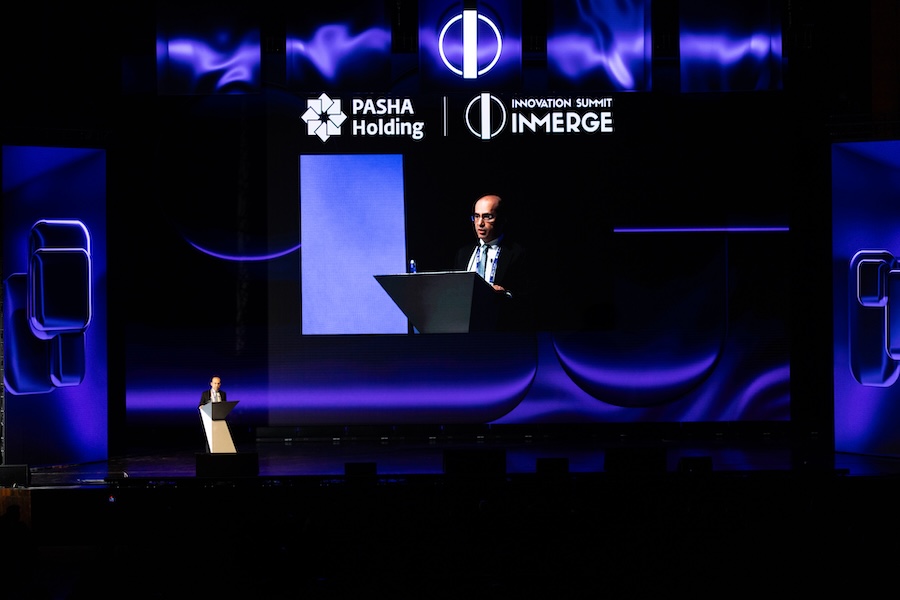
PASHA has tried to build that future rather than wait for it, backing the country’s first venture capital fund and cybersecurity school, funding scholarships in technical fields, and building out its own technology arm and Bir, a digital ecosystem now used for roughly every second digital payment made in the country. Gasimov applies the same discipline inside his own boardroom, where he has said meetings should run on two questions rather than instinct alone: why something is happening, and what if the usual answer turns out to be wrong. Much of that thinking runs through InMerge, the innovation summit PASHA built from scratch and now stages across the region. Gasimov talks about it the way a parent talks about a difficult teenager. “It’s still our baby,” he says, “growing fast, and already misbehaving in exactly the ways you’d want as the platform becomes more ambitious in its outreach with roadshows in Istanbul, Berlin and Tashkent in recent months.”
Azerbaijan has spent the better part of a decade turning conviction into hard infrastructure rather than simply talking about it. Freight moving along the Middle Corridor, the route linking China to Europe via Central Asia and the South Caucasus, has grown roughly sixfold since 2021, and the Alat port outside Baku is being expanded to handle much of that growth. Azerbaijan’s transport minister, chairing the International Transport Forum this year for the first time, put it plainly to delegates: resilience in logistics is no longer a question of engineering. It is a question of who has already built the track.
There is another side to Gasimov’s thinking. He describes himself as “fundamentally an anti-conflict person” who believes in peace, and that belief shapes how he talks about Azerbaijan’s neighborhood as much as any spreadsheet does. The country maintains workable relationships with Russia and the West at once, with Iran and Israel, with Turkey and, increasingly, with China, a list few countries anywhere can claim. Gasimov treats it less as diplomatic trivia than as the natural extension of a place built to hold different worlds without forcing a choice. Hosting COP29 in Baku mattered both for the climate agreements it produced, and for what it proved the country could execute at scale, right after Dubai had set the bar. “It was a success as we managed to triple the Collective Quantified Goal (CQG), which committed developed nations to mobilize $300 billion annually by 2035 to help developing countries transition to clean energy and adapt to climate change. At the same time COP29 changed how we see ourselves, as once you prove something like that in practice, you stop wondering if you are capable of it.”
Whether global capital arrives this year or five years from now almost seems beside the point. Azerbaijan has already decided what kind of economy it intends to become, and it has stopped waiting for permission to build it. The rest of the world is beginning to notice.