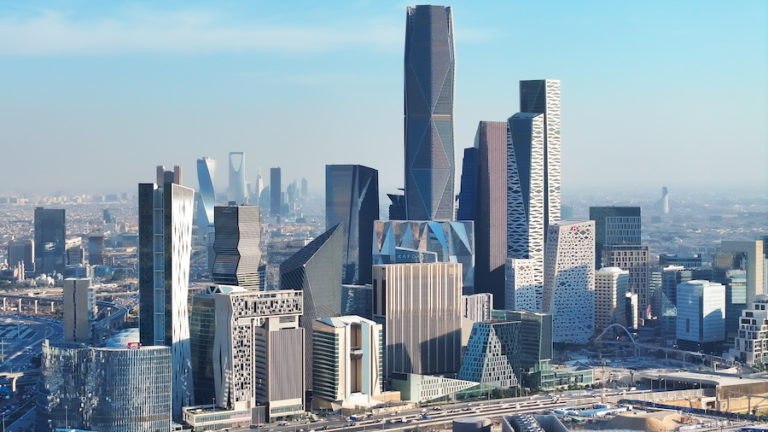

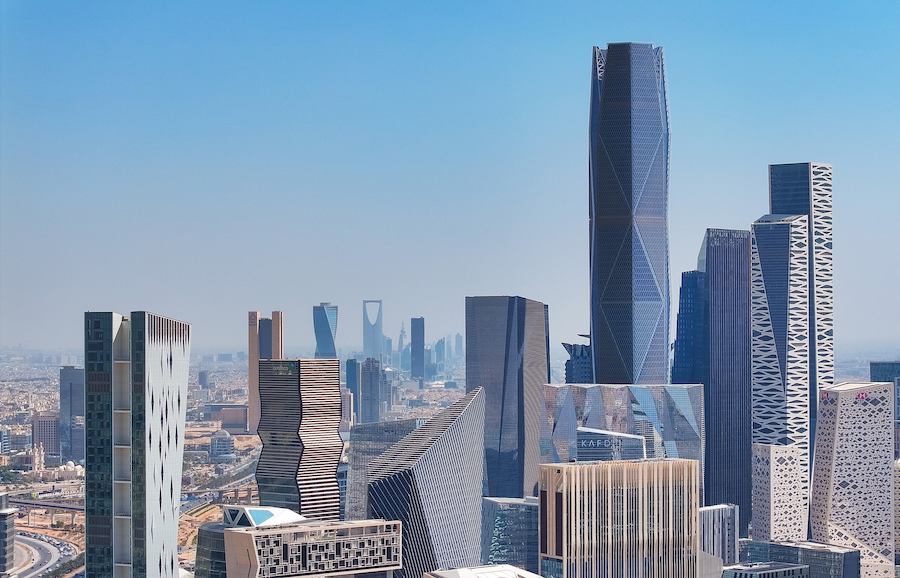
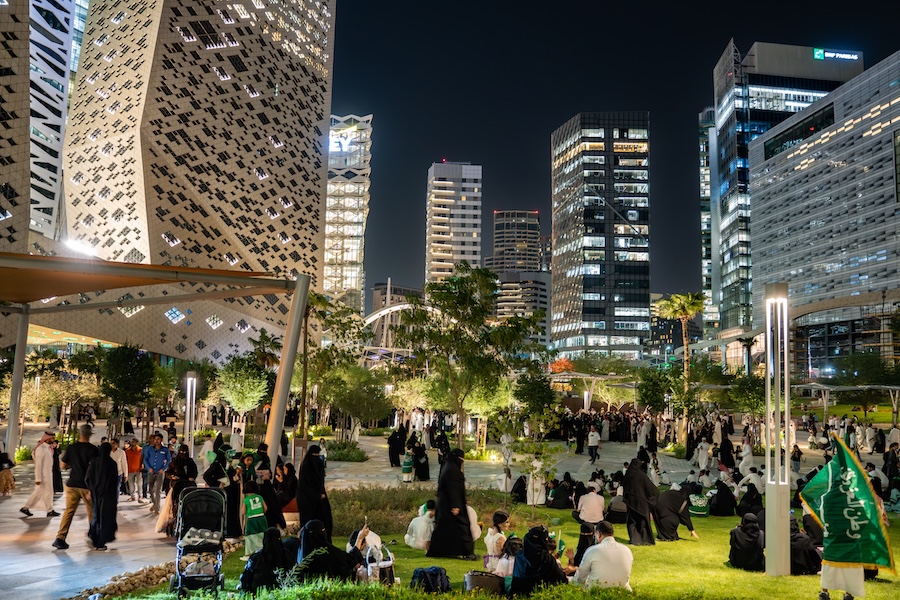
As global investors scan the map for the next market that can combine scale, ambition, stability, and serious economic momentum, Saudi Arabia has become impossible to ignore. The kingdom is increasingly driving growth. And in Riyadh, the King Abdullah Financial District is where capital, corporate ambition, and a new vision of urban life now converge with singular force.
The most persuasive thing about KAFD is that it does not need to overstate its own significance. You feel it as soon as you arrive. Executives spill out of meetings into polished cafés, residents cross the district on foot, and the city’s new infrastructure feels both metropolitan and seamless. This is not a place waiting to happen. It is happening now.
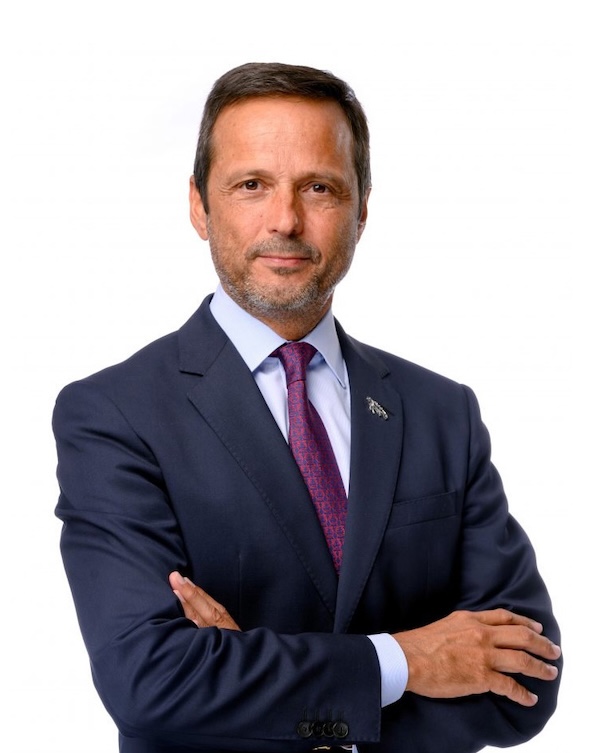
For KAFD managing director John Pagano, that shift is precisely what makes KAFD so significant. “It always had ambition and vision,” he says. “Today, it is the heartbeat of Riyadh, the center of financial and economic power.”
KAFD was conceived as a fully integrated environment where offices, homes, hospitality, retail, and entertainment reinforce one another. “People want to live, work, and play in the center of a city,” he says. “And KAFD is the manifestation of that.”
Rather than growing gradually into a mixed-use destination, KAFD was designed from day one as an integrated urban ecosystem for the way modern business now wants to operate. “Canary Wharf in London evolved over 25 years,” Pagano says. “KAFD was conceived and delivered as a complete district from the outset. That is what makes it so distinctive.”
“KAFD is not just a financial district. It is a complete urban ecosystem.”
John Pagano, managing director, King Abdullah Financial District (KAFD)
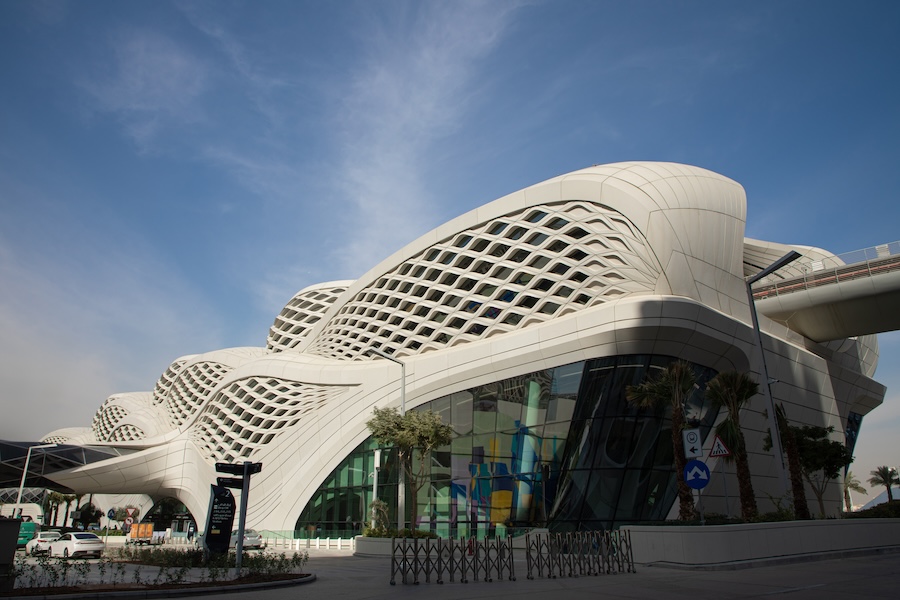
This vision is no longer theoretical. “Over 80% of the offices are now occupied,” Pagano says. The opening of the futuristic KAFD Metro Station in 2024 was “a game changer,” he says, and daily footfall now averages around 30,000 people. The client mix speaks for itself, from Goldman Sachs, Barclays, and HSBC to Saudi Aramco, Red Sea Global, and Deloitte. The district now hosts 20 regional headquarters, over 140 companies, and a community of more than 20,000 professionals.
That is not just the tenant mix. It is critical mass.
The premium dimension of KAFD is becoming harder to miss. Pagano points to the Kimpton KAFD, the brand’s first property in the Middle East, and the newly opened W Riyadh, now anchoring a pipeline of luxury hotels and branded residences.
KAFD was planned as a smart, 15-minute walking city, with strong digital connectivity, a Samsung technology partnership, air-conditioned skywalks, metro links, and a future monorail. Its climate-controlled skywalks form the world’s largest pedestrian skyway network, recognized by Guinness World Records.
KAFD has also become one of the strongest arguments yet for Riyadh itself. “Riyadh is a vibrant city,” Pagano says. “It has energy, youth and sophistication, and a pace that is becoming harder to ignore.” Just as importantly, “It is a very livable city,” he adds, shaped by pedestrian-first design, strong health care services, events and entertainment, and an ease of movement that makes daily life feel effortless.
For investors, the appeal is easy to understand: Saudi Arabia is the region’s largest economy, Riyadh is expanding at speed, and KAFD offers an unusually complete proposition within that growth story. It brings together the institutions that matter, the infrastructure global business now expects, and a high quality of life. KAFD is also the world’s largest LEED Platinum-certified mixed-use business district—a distinction that gives its sustainability credentials global credibility.
“Investment follows where there’s growth,” Pagano says. “KAFD’s achievement is that it makes that growth tangible enough to walk through, work in, and believe.”
Financial District (KAFD)
When did KAFD stop being a vision and become undeniable?
When people stopped merely talking about it and started using it. Offices filled, residents moved in, the metro station opened, and the district began to behave like a real city. It now has the footfall, energy, and commercial life that turn ambition into proof. It is no longer a promise. It is the heartbeat of Riyadh.
What makes KAFD stronger than a traditional financial district?
Because it offers far more than office space. It brings together capital, regulators, professional services, hospitality, homes, and retail in one connected environment.
That creates the kind of ecosystem modern business actually needs—one that is efficient, persuasive, and built around how people want to live and work now.
Why should international investors be paying attention to KAFD now?
Because this is where Riyadh’s growth becomes most tangible. Saudi Arabia is the largest economy in the region and a G20 economy, while Riyadh is expanding at extraordinary speed and attracting the kind of young, globally minded talent that drives the next phase of business growth. KAFD already contributes $2.5 billion to Saudi GDP, with that figure projected to exceed $8.7 billion by 2030. It brings together access, infrastructure, credibility, and momentum in one place. If you want to understand where the city is heading, or establish a serious presence within it, this is where the future already has an address.
As published in FORTUNE magazine