




Madrid doesn’t need another venue pretending to be cultural. It needs places that actually generate culture. Places that pull different worlds into the same room and let friction do the work. That’s exactly what CUPRA City Garage Madrid has become. Not just a showroom. Not just a stage. A live platform where ideas, people, machines, and disciplines collide in real time.
Two years in, the scale is impossible to ignore. More than 88,000 visitors in 2025. Over 220 events. Growth pushing 30 percent year on year. A calendar that now runs denser and more diverse than many legacy institutions in the city. But the numbers aren’t the flex. The ambition is.
This is still a place where cars are very much present. New CUPRA models sit confidently within the space, not hidden away or over explained, but integrated into the rhythm of everything else that’s happening. People arrive for a talk, a performance, a debate, a launch, and find themselves moving naturally between culture and product. The showroom doesn’t interrupt the experience. It’s part of it. Cars aren’t positioned as objects to be sold. They’re treated as expressions of the same mindset driving the programme around them.
That mindset refuses to sit in a single lane. One night it’s music. The next it’s literature, film, fashion, science, sport, mobility, debate. Pedro Almodóvar and Penélope Cruz cross paths with Ken Follett and Sara García Alonso. Guitarricadelafuente shares the programme with astronauts, athletes, designers, and engineers. These aren’t headline names dropped for prestige. They’re signals of range. Proof that the Garage isn’t curating a scene. It’s building an ecosystem.
“As the largest CUPRA City Garage in the world, this space has become a real magnet for the city.”
Cristina Vall-Llosada, MD CUPRA City Garage Madrid & CASA SEAT.
The atmosphere inside reflects that confidence. No hushed tones. No polite distance. People don’t drift through. They engage. Talk. Stay. Return. The Garage behaves like a social engine, constantly recalibrating itself through its audience. That’s why it works in Madrid, a city that doesn’t consume culture passively. Madrid interrogates it.
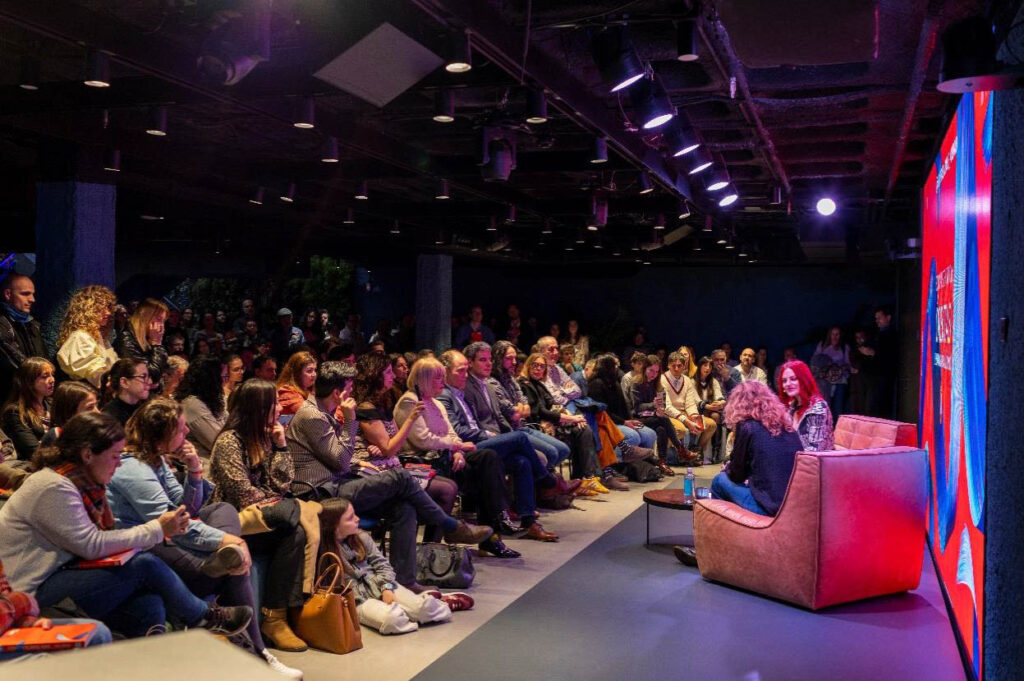
The immersive room has become one of the most powerful tools in that equation. A space that shifts identity depending on what it’s hosting. Sometimes intense. Sometimes playful. Sometimes confrontational. Light and sound aren’t decoration here. They’re language. The room doesn’t ask for attention. It demands participation.
There’s also a deliberate future facing tension running through the programme. Emerging artists share space with established voices. Podcasts are recorded live. Running tribes form outside the front door. Conversations about electrification, mobility, and urban life are framed as cultural questions, not technical briefings. Formula E cars sit alongside book launches and design talks. Movement is treated as mindset, but also as something you can touch, test, and ultimately take home.
As the largest CUPRA City Garage globally, Madrid has become a reference point for what brand led spaces can be when they stop trying to separate commerce from culture and instead let them feed each other. The growing digital community is just an extension of what’s already happening on the ground.
People don’t come here only to look at cars. And they don’t come only for events. They come because everything is in motion. Because the Garage doesn’t choose between selling and storytelling. It does both, at the same time. And in a city that thrives on energy, friction, and expression, that balance is exactly why it’s working.