



By Mohamed Alabbar

When I was younger, I thought success was about building bigger companies. Like most entrepreneurs, I measured progress by growth: more projects, more markets, more customers, more opportunity. There is nothing wrong with that. Ambition is what allows businesses, and indeed countries, to move forward. What I did not understand then was that reputation is not something you defend once you have succeeded. It is something you build in every decision along the way, long before anyone is watching.
It builds trust. And trust, in the end, becomes your name.
I have spent my career in industries where people make some of the biggest financial decisions of their lives. When a family buys a home, they are not simply buying concrete, glass and stone. They are choosing where their children will grow up, where birthdays will be celebrated, where grandchildren may one day visit. They are placing their confidence in people they may only have met a handful of times. That is an extraordinary responsibility, and I have always believed it should be treated as one.
People sometimes describe me as demanding. My colleagues might choose a stronger word. They know I will ask for another drawing if something does not feel right, question materials long after everyone else believes a decision has been made, or spend twenty minutes on a detail that many people would never notice. I have changed decisions that were perfectly acceptable simply because I believed they could be better. I have never done this to make life difficult for the people around me. I do it because every one of those decisions eventually carries my name. Quality is not about satisfying my own standards. It is about respecting the people who have placed their trust in us.
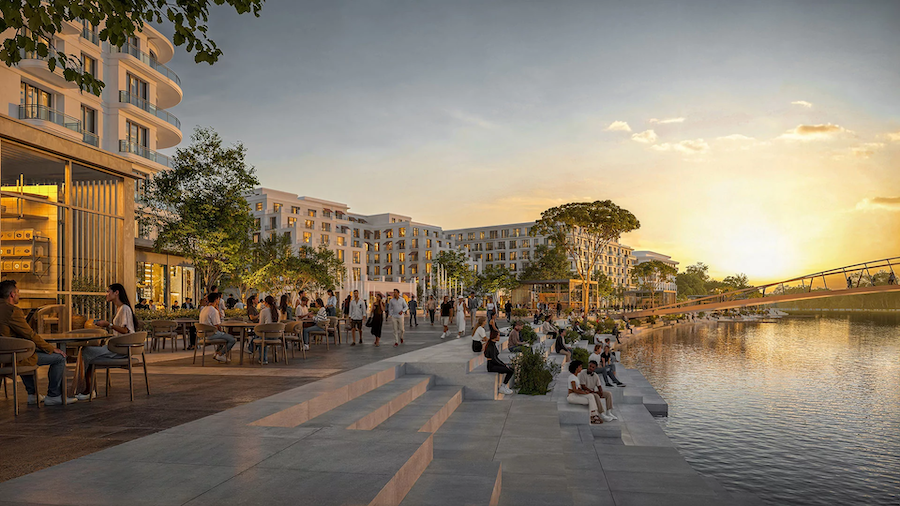
When I acquired Antognolla in Italy, I wanted the experience to feel unmistakably Italian rather than internationally luxurious. Every material, every proportion and every finish had to earn its place. Authenticity mattered more to me than following what was familiar or most efficient. Today we even use artificial intelligence to review architectural details, because every decision should honour the history of that place. People may never consciously notice why somewhere feels authentic, but they almost always recognise when it does not.
The same principle applies to every business. Reputation is rarely built through dramatic moments. It grows quietly through hundreds of decisions that nobody applauds: choosing the better stone even when the cheaper one would probably do, delaying an opening because the work is not yet good enough, answering the telephone when a customer has a problem years after the sale has been completed. Those moments never appear in annual reports. Together, they become the foundation on which every successful company is built.
I have always admired countries that think the same way. People often ask why investors have such confidence in the UAE. They point to the airports, the infrastructure and the skyline, but those things are simply the visible expression of something much deeper. Trust was earned long before those buildings appeared, through consistency, transparency and the determination to keep improving year after year. A country’s reputation, like a company’s, is built patiently and protected carefully, because once it is damaged it is never easy to restore.
None of this becomes less important because of artificial intelligence. If anything, the opposite is true. AI will help every business become faster, more efficient and better informed, and I have embraced it enthusiastically. But when technology becomes available to everyone, judgement becomes even more valuable. AI can help me review a drawing or analyse a business. It cannot decide what standards I want my name to represent. That remains my responsibility, and it always will.
As I have grown older, I have realised that buildings eventually become part of a city’s landscape, and financial results become part of history. What people remember is simpler than that. They remember whether you kept your word, whether you cared enough to get the small things right, and whether, when they placed their trust in you, you proved worthy of it.
In the end, your greatest investment is not the next project you build. It is the name you leave behind.
This is part four of twelve. Beyond Profit is a twelve-part series published exclusively on The Buzz in which Mohamed Alabbar, founder of Emaar and Noon, family man, and one of the Arab world’s most influential business leaders, shares personal reflections on leadership, legacy and what it really means to build something worthwhile. The series moves beyond towers and financial results to explore the values, experiences and hard-won lessons of a man who grew up with nothing, has spent a lifetime building cities, businesses and opportunities across more than twenty countries, and is now thinking harder than most about the kind of future we are all building together: human, technological and everything in between. A new instalment publishes each month.