




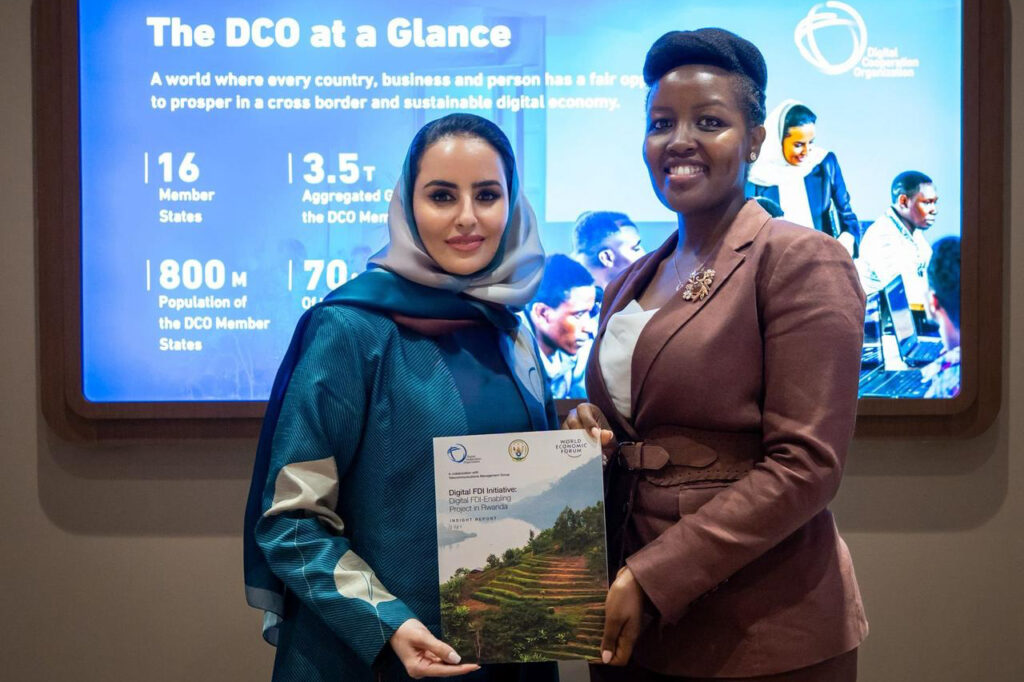
In Riyadh this week, the Digital Cooperation Organization took another decisive step in rewriting the global rulebook for digital growth. Alongside Rwanda’s Ministry of ICT and Innovation and the World Economic Forum, it unveiled the Digital FDI Rwanda Report — a blueprint for how digital foreign investment can accelerate prosperity, not just profit.
For the DCO, this is more than a partnership. It is proof of concept. The organization, founded in 2020 to champion inclusive and sustainable digital economies, is showing how collaboration across borders can turn ambition into action. Rwanda’s digital revolution has become one of its most striking success stories — a case study in what happens when courage and policy meet purpose.
“Rwanda’s story proves that digital investment is not only about capital. It is about courage, collaboration, and conviction,” said DCO Secretary-General Deemah AlYahya at the launch during the Future Investment Initiative. “When governments, innovators, and investors align their ambitions, they translate the abstract concept of prosperity into tangible progress that uplifts people’s lives.”
That is the DCO’s signature philosophy — digital prosperity for all. It connects 16 member states that together represent a combined GDP of more than 3.5 trillion dollars and a population of over 800 million people, most of them under 35. The organization acts as both architect and accelerator of digital transformation, helping its members to harmonize data policies, scale innovation, and unlock the power of youth and entrepreneurship.
Rwanda’s Digital FDI roadmap embodies that mission. It calls for clear data governance, transparent cybersecurity rules, and seamless investor facilitation — the kind of structures that give confidence to global technology companies seeking to establish a presence in Africa. Already, Rwanda’s fintech and cloud sectors are expanding rapidly, while local skills programs are turning digital literacy into economic mobility.

For H.E. Paula Ingabire, Rwanda’s minister of ICT and innovation, the report reinforces a national vision built on inclusion and ingenuity. “Our goal is to continue building a global business environment for technology companies by strengthening trust in our data ecosystem, improving investor facilitation, and expanding digital skills,” she said. Her words mirror the DCO’s wider ambition — to transform digital readiness into resilience, and resilience into opportunity.
The DCO’s influence is felt not in headlines but in frameworks — in the quiet diplomacy of enabling cross-border data flows, in the confidence investors feel entering new markets, in the opportunities opening up for startups from Kigali to Karachi. By turning policy into practice, the organization is demonstrating how emerging economies can lead the conversation on digital investment rather than follow it.
The Digital FDI Rwanda Report is the latest chapter in that evolving narrative. It’s not just about attracting capital; it’s about building trust, talent, and transformation. For the DCO and its partners, the message is clear. The digital economy will not be shaped by geography but by governance, not by size but by vision. Rwanda and the DCO have just reminded the world what leadership in the digital age truly looks like.